




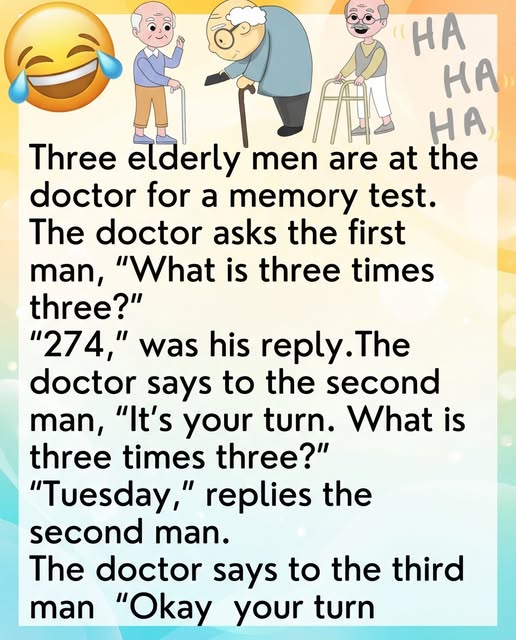
Doctor’s offices aren’t usually known for humor, but one quiet waiting room proved that laughter can appear when you least expect it. Three elderly friends sat side by side, coats folded neatly, canes within reach, waiting for a routine memory check. It wasn’t a serious appointment—just a gentle assessment meant to see how well their minds were keeping pace with time. Still, each man seemed determined to show he was sharper than he looked, especially the first one called in, who straightened up with unmistakable confidence.
The doctor began with a question so simple it seemed impossible to miss: “What is three times three?” The first man paused, squinting as if the answer were hiding just beyond reach. After a thoughtful silence, he announced his response with pride—an impressively large number that made no mathematical sense at all. The doctor smiled politely and moved on. The second man, clearly enjoying the moment, leaned forward and answered the same question with a completely unexpected word. His grin suggested he knew exactly how amusing his reply sounded, and the room grew lighter with suppressed laughter.
By the time the third man was asked, everyone was waiting for another surprise. He answered correctly without hesitation, earning a nod of approval from the doctor. Then, with perfect timing, he explained his reasoning—linking the previous two wildly incorrect answers in a way that made his logic sound almost believable. The punchline landed instantly. Laughter filled the room, spilling over in a way no test result ever could. For a moment, memory scores didn’t matter at all.
As the three friends left together, still chuckling and teasing one another, it was clear that something far more important than recall had been demonstrated. While memories may blur and numbers may wander, humor has a way of staying sharp. Watching them stroll down the sidewalk, anyone could see it plainly: laughter doesn’t fade with age—it just gets better with practice.
