



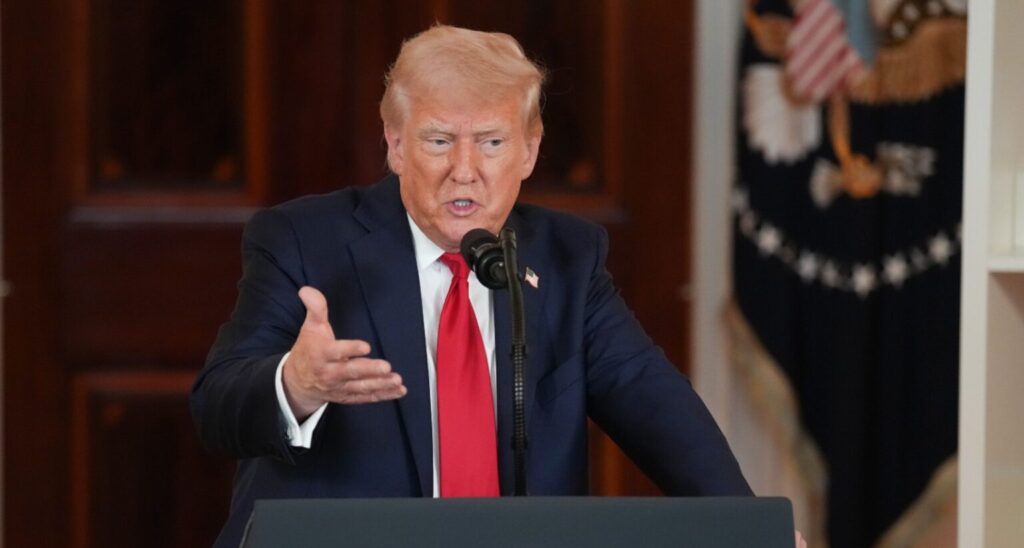
President Donald Trump’s announcement that South Africa will not be invited to the 2026 G-20 summit—scheduled to take place in Miami, Florida—has ignited an international political uproar and raised pressing questions about the future of global economic cooperation. In a statement released last week, Trump claimed that the country was responsible for what he described as “horrific human rights abuses,” asserting that the South African government was “killing white people and randomly allowing their farms to be taken from them.” These remarks, posted on Trump’s Truth Social account, were framed as justification for barring South Africa from attending the annual gathering of major global economies. The G-20, which includes both advanced and emerging nations, was founded on principles of inclusivity and cooperation—yet Trump’s declaration represents a major departure from that norm. Trump insisted that his decision was final, saying that under his directive, South Africa would not be welcome at the 2026 summit, which the United States is slated to host. His comments immediately triggered a wave of responses from global political leaders, diplomatic experts, and analysts who noted that such a move would be without precedent. The G-20 has never expelled a member country, and doing so could set a far-reaching precedent that risks destabilizing one of the world’s most influential economic forums. Trump’s message reflects a broader shift in his foreign policy outlook as he approaches the later years of his second term—an approach marked by more confrontational rhetoric, sharper criticism of longtime partners, and a willingness to use economic forums as leverage in geopolitical disputes.
In response to Trump’s allegations and proposed exclusion, Clayson Monyela, head of diplomacy for South Africa’s Department of International Relations and Cooperation, issued an emphatic rebuttal. Speaking to Fox News Digital, Monyela stressed that South Africa is a founding member of the G-20 and therefore does not rely on invitations to attend the summit. “We don’t get invited to G-20 meetings and leaders’ summits,” he stated. “Those are gatherings of members. If other members allow this then the G-20 will die.” Monyela’s comments highlighted both the logistical impracticality and geopolitical consequences of Trump’s announcement. He further revealed that multiple G-20 member states had privately signaled their willingness to boycott the 2026 U.S.-hosted summit if South Africa were excluded. Such a boycott would be a dramatic escalation—and a potentially devastating blow to the legitimacy of the G-20 itself. His remarks underscored not only the diplomatic stakes at hand but also the broader political implications for U.S. relations with African nations, many of which view South Africa as a regional leader and key economic partner. Analysts observing the dispute noted that the exclusion of one of the continent’s largest economies could fracture the collective spirit of the G-20 and undermine its mission of global economic coordination. Monyela’s warnings reflect South Africa’s broader attempt to assert its sovereignty, counter the narrative being promoted by Trump, and defend its continued status within the G-20 framework.
If Trump’s proposal were to be enacted, it would mark the first time in the G-20’s more than 20-year history that a member state had been officially barred from the summit. The G-20, established in 1999 and elevated to a leaders’ forum in the late 2000s, has long prided itself on its non-exclusionary structure, working to integrate emerging economies into global decision-making. Yet the tradition of unity has already faced strain. Earlier this month, the United States—under the Trump administration—boycotted the 2025 G-20 meeting in Johannesburg, signaling an increasingly adversarial stance toward South Africa. That boycott centered in part on the Johannesburg summit’s prioritization of climate and development issues over economic policy. Trump’s administration argued that the South African government had failed to confront violence in rural farming communities, and he accused the Johannesburg organizers of promoting a progressive, globalist agenda at odds with U.S. priorities. Critics viewed the U.S. boycott as a retreat from international cooperation, while Trump supporters framed it as a necessary stand against what they described as politically motivated global institutions. The escalating confrontation between the U.S. and South Africa has fueled concerns that Trump’s administration may be steering the G-20 away from its founding purpose. By refusing to participate in the 2025 summit and now threatening to bar South Africa entirely, the U.S. is placing the institution at a crossroads—one in which the future cohesion of the group may depend on whether other nations accept or resist the precedent Trump hopes to establish.
Trump’s Truth Social post did not stop at barring South Africa from the G-20. He further announced that he planned to suspend all U.S. payments and subsidies to the country, accusing its government of conduct that renders it “unworthy of membership anywhere.” This follows a pattern of increasing diplomatic tension between Washington and Pretoria throughout the year. Relations deteriorated sharply in February when Trump suspended U.S. aid to South Africa, arguing that the government discriminated against white farmers. The situation escalated again in March when the United States expelled South African Ambassador Ebrahim Rasool, declaring him “persona non grata.” The grounds for this expulsion stemmed from comments Rasool reportedly made accusing Trump of leading a global white supremacist movement—remarks sharply condemned by Secretary of State Marco Rubio, who went so far as to denounce Rasool publicly on social media. These diplomatic clashes culminated in a tense meeting between Trump and South African President Cyril Ramaphosa in May, during which Trump pressed Ramaphosa over allegations that white Afrikaners were being systematically targeted. Ramaphosa rejected these claims, asserting that he had seen no credible evidence to support them. Nonetheless, the incident further strained relations between the two nations, amplifying Trump’s narrative that the South African government was failing to protect its citizens and was undeserving of its standing within the international community.
The current conflict between the U.S. and South Africa cannot be understood in isolation; it emerges from years of competing political narratives, mutual suspicion, and broader geopolitical shifts. Trump’s insistence that South Africa is committing human rights abuses echoes earlier controversies, including international debates over land expropriation without compensation and rural violence. Although these issues have long been politically sensitive and deeply polarizing within South Africa, Trump’s framing of them has drawn global attention and spurred heated diplomatic exchanges. South Africa, for its part, has repeatedly maintained that Trump’s characterizations are exaggerated and misleading, arguing that violence in the country affects communities of all races and that land reform policies are undergoing constitutional review rather than arbitrary implementation. Meanwhile, tensions have been compounded by South Africa’s foreign policy positions, including its relations with Iran, Hamas, and other countries that Trump’s administration views as adversarial. Notably, Rasool’s comments in Johannesburg—where he attempted to contextualize Trump’s opposition to South Africa’s land policies and its alliances—only further inflamed tempers. Each of these disputes has contributed to the growing rift between the two governments, setting the stage for Trump’s dramatic attempt to exclude South Africa from the G-20. As global powers observe this widening rift, some analysts warn that the conflict has the potential to reshape diplomatic alignments, particularly in Africa, where many countries have been deepening ties with China and Russia amid declining trust in Western political structures.
The fallout from Trump’s announcement continues to ripple across diplomatic circles, raising urgent questions about the stability of the G-20 and the future of U.S.–South Africa relations. If South Africa were barred, and if other nations followed through on threats to boycott the summit, the 2026 G-20 meeting in Miami could be overshadowed by a crisis of legitimacy. Such a development would have implications far beyond one bilateral dispute, potentially weakening the institution’s ability to coordinate global economic policy at a time of rising geopolitical instability. For South Africa, the controversy presents both challenges and opportunities: while the accusations leveled against it may damage its international reputation in some circles, the wave of support from other G-20 members indicates that many nations view Trump’s approach as an overreach. For the United States, the situation underscores the shifting nature of its global leadership under Trump’s second administration—a leadership marked by unilateral decision-making, confrontational diplomacy, and the assertion that multilateral institutions must align with American priorities or risk U.S. disengagement. As the world looks ahead to the 2026 summit, the unresolved dispute threatens to shape not only the dynamics of the G-20 but also the broader trajectory of international cooperation. Whether the crisis escalates or subsides will depend on the actions of member nations, the diplomacy of the coming months, and the degree to which the global community is willing to challenge or accommodate Trump’s unprecedented move.
