
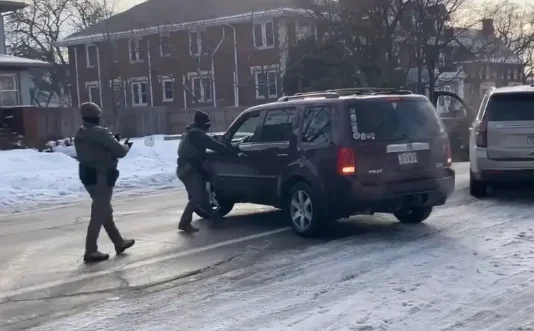
Recent reports from the New York Post allege that organizations characterizing themselves as radical leftist groups—including one receiving significant funding from billionaire George Soros—are driving the ongoing protests against Immigration and Customs Enforcement (ICE) in Minnesota.
The heightened tensions follow a tragic incident on Wednesday involving the death of Renee Nicole Good during a confrontation with federal agents.
Financial Ties and Organizational Structure
Indivisible Twin Cities, a group describing itself as a grassroots network of volunteers, has been identified as a primary organizer of demonstrations opposing ICE raids in the region.
According to public financial records, the Open Society Foundations, chaired by George Soros, provided $7,850,000 to the Washington, DC-based Indivisible Project between 2018 and 2023. The project’s stated mission involves a movement to defeat the “Trump agenda.”
This network has previously been linked to other high-profile demonstrations, including protests in favor of Venezuela and the nationwide “No Kings” protests directed at the Trump administration.
While Indivisible Twin Cities operates as a key protest group, its leadership structure remains opaque, with no specific leaders listed on its official website.
The Incident: Conflicting Narratives
Tensions escalated dramatically on Wednesday when Renee Nicole Good was shot and killed. Authorities allege the incident occurred after she attempted to run over an ICE agent with her vehicle. However, activist groups dispute this narrative.
Jaylani Hussein, executive director of the Minnesota chapter of the Council on American-Islamic Relations (CAIR), spoke out against ICE during a demonstration following the event.
“A young observer killed in the line of observing, we believe in a peaceful manner. They are lying, as you hear today. They already shared lies about what took place,” Hussein stated via megaphone at the protest.
While leftist sources have characterized Good as a “legal observer” present at the raid on her home, the Post reports that she was a known anti-ICE “warrior” who had moved from Colorado to Minnesota. She was reportedly a member of “ICE Watch,” a collective of activists dedicated to halting ICE operations in Minneapolis.
Leadership and Community Response
Several prominent local figures have been associated with the organization and support of these protests.
Nekima Levy Armstrong
Nekima Levy Armstrong, founder of the Racial Justice Network, has reportedly taken a leadership role in the current demonstrations. Social media activity suggests the civil rights attorney is instrumental in organizing “legal observers” dispatched to record federal agents during raids.
Armstrong, who was a significant figure during the May 2020 George Floyd protests, recently criticized Governor Tim Walz’s decision not to seek re-election amid a state welfare fraud case.
“When Democrats respond to bad-faith attacks by retreating, they don’t just lose candidates,” Armstrong wrote on Facebook. “They legitimize the tactic… Whatever the intentions, the cumulative effect is strategic capitulation.”
Edwin Torres DeSantiago
Another key figure identified is Edwin Torres DeSantiago, head of the Immigrant Defense Network. This umbrella organization represents over 90 nonprofits and religious groups advocating for immigrant rights.
DeSantiago, the first undocumented immigrant to earn a doctorate from the University of Minnesota, publicly addressed President Trump following Good’s death, accusing the administration of spreading “terror and chaos” in Minneapolis.
Legal Analysis and Potential Charges
Legal analysts are weighing in on the ramifications of the January 7 encounter. Speaking on Fox & Friends, Fox News legal analyst Gregg Jarrett suggested that the investigation could extend beyond the deceased.
Jarrett indicated that Rebecca Good, the spouse of Renee Good, could potentially face legal scrutiny. He noted that charges such as aiding and abetting could be relevant if evidence suggests she encouraged or assisted in actions that impeded law enforcement.
“The legal evaluation would hinge on motive and whether there was intent to obstruct officers,” Jarrett explained, telling co-host Lawrence Jones that authorities may look into whether there was “aiding and abetting fleeing police with a domestic terrorism motive.”
