




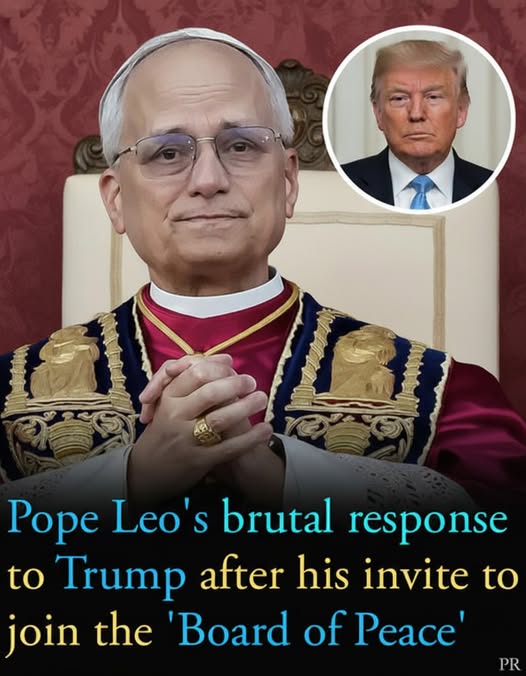
Pope Leo has delivered a blunt response to an invitation from President Donald Trump to join the newly proposed “Board of Peace.” Firmly rejecting the idea and questioning its underlying intentions, the Pope emphasized the need for moral independence and warned against the politicization of global spiritual authority.
The exchange has fueled intense debate over international relations, diplomatic strategy, and the boundaries between faith leadership and political initiatives worldwide.
The Strategic Framework of the ‘Board of Peace’
President Donald Trump recently introduced the “Board of Peace,” presenting the initiative as an ambitious new mechanism designed to resolve some of the world’s most persistent international conflicts. Announced with considerable fanfare, the global initiative was framed as a streamlined approach to diplomacy.
Trump positioned this new board as a way to bypass what he has often characterized as slow or ineffective international institutions. Pointing specifically to conflict zones such as Gaza, he argued that decisive, coordinated action is urgently needed. By proposing this board, Trump positioned the United States as the driving force behind a new geopolitical structure intended to:
-
Foster international dialogue
-
Negotiate complex geopolitical settlements
-
Promote global economic stability
Central to the announcement was his assertion that the global community requires innovative diplomatic solutions rather than relying solely on existing legacy organizations that, in his view, have struggled to deliver lasting peace.
The $1 Billion Financial Requirement and Global Backlash
The organizational structure of the proposed Board of Peace quickly became a focal point of international economic and political discussion. According to the plan, nations wishing to secure permanent membership are required to make a substantial financial commitment of $1 billion.
Supporters of the initiative argued that this economic threshold would ensure seriousness of purpose and provide necessary funding for global peace-building initiatives, humanitarian efforts, and high-level diplomatic engagement. Critics, however, viewed the financial requirement as a barrier to entry, warning it could limit global participation and skew geopolitical influence toward wealthier or politically aligned states.
The $1 billion threshold prompted immediate reactions from governments around the world. Several key Western allies declined to participate, including:
-
Germany
-
Canada
-
France
-
Italy
-
Norway
-
Sweden
-
The United Kingdom
-
Ukraine
While official explanations varied, the decisions of these nations suggested deep reservations regarding the board’s operational framework, leadership structure, and its integration with existing international systems.
Geopolitical Shifts: Nations Accepting the Invitation
At the same time, the initiative successfully attracted financial and diplomatic backing from a specific coalition of countries. The following nations signaled their willingness to become part of the new governing body:
-
Israel
-
Argentina
-
Russia
-
Hungary
-
Saudi Arabia
Their participation lent the proposal a measure of credibility, demonstrating that it was not universally dismissed. Yet, the contrasting global responses underscored clear geopolitical divisions.
Industry observers and political analysts noted that the participating nations often shared closer alignment with Trump’s foreign policy outlook or had strategic geopolitical reasons to support an alternative diplomatic forum. The emerging composition of the board has raised broader questions about whether it will function as a genuinely multilateral peace initiative or simply reflect the foreign policy priorities of a more limited economic coalition.
The Vatican’s Response: Pope Leo’s Stance on Global Diplomacy
Among the most closely watched aspects of the announcement was Trump’s invitation to Pope Leo, the leader of the Roman Catholic Church. Extending an offer to the Pope was widely interpreted as an attempt to infuse the Board of Peace with moral authority and global spiritual legitimacy.
As the head of a faith community numbering more than a billion people worldwide, Pope Leo holds significant influence in international humanitarian and diplomatic circles. When the invitation was first made public in January, the Vatican responded cautiously. Officials indicated that the Pope was reflecting on the proposal, maintaining the Holy See’s longstanding tradition of deliberate and nuanced international diplomacy.
In the months that followed, anticipation grew regarding the Vatican’s final decision. Ultimately, reports confirmed that Pope Leo chose to decline the invitation. According to accounts from Vatican sources, his response was firm and conveyed clear reservations about the concept itself.
Historically, the Vatican has emphasized multilateralism, dialogue, and cooperation through established international institutions. By declining to join a board spearheaded by a single national government, Pope Leo signaled concern about concentrating global peace efforts within a structure that might lack a broad, balanced international consensus.
Reinforcing the Role of the United Nations
Cardinal Pietro Parolin, the Vatican’s Secretary of State and chief diplomat, elaborated on the strategic reasoning behind the decision. He explained that Pope Leo believes complex international conflicts, such as the one in Gaza, should be addressed through the United Nations—an institution specifically created to manage global disputes through collective international participation.
From the Vatican’s perspective, the legitimacy and operational effectiveness of peace initiatives are strengthened when they operate within widely recognized, multilateral systems.
While acknowledging the importance of creative approaches to international diplomacy, Cardinal Parolin emphasized that the Church supports solutions grounded in global cooperation among nations. The Vatican remains opposed to structures led by a single country, regardless of its economic or political influence. The Holy See’s stance reinforces its longstanding commitment to the principles of shared responsibility, even as new proposals like the Board of Peace attempt to reshape the landscape of international peacemaking.
